



Ever since Facebook changed its name to Meta, the term metaverse has been in the news quite a lot. It’s a gaming platform, a virtual retail destination, a training tool, an advertising channel, and more. But it’s hard to say exactly what the metaverse is. However, the metaverse is real, potentially revolutionary, and has immense opportunities.
At its most basic, the metaverse has three features which are a sense of immersion, real-time interactivity, and user agency. The full vision of the metaverse will include interoperability across platforms and devices, concurrency with thousands of people interacting simultaneously, and use cases spanning human activity well beyond gaming.
There is a lot of interest in the development of the metaverse. A lot of money is being invested, and gaming is continuing to help develop it. There are also new uses for the metaverse that are helpful for both businesses and consumers.
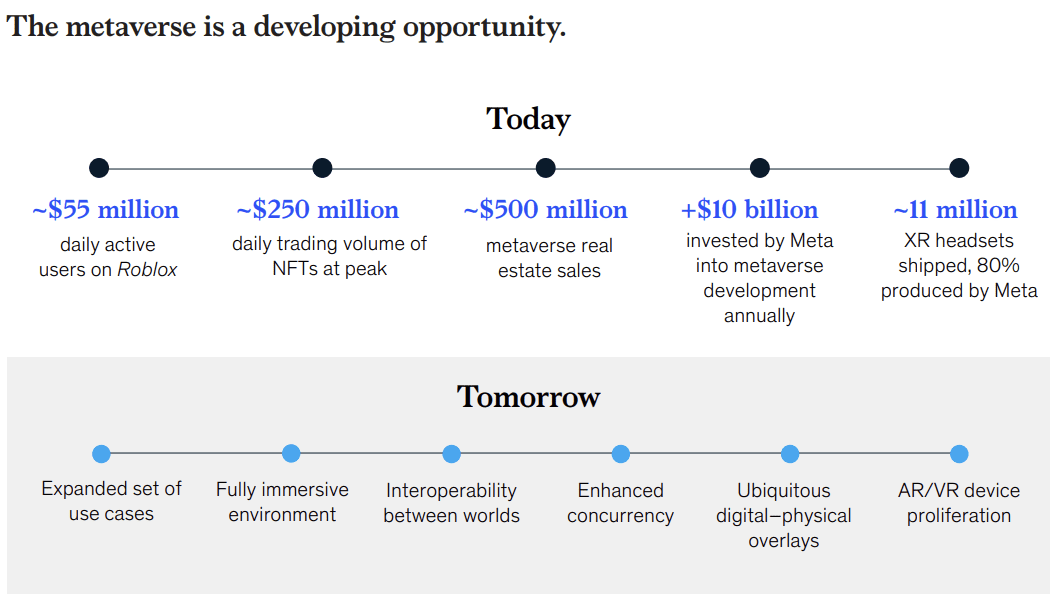
Metaverse investments
The investment in artificial intelligence (AI), a few years ago, was estimated at around $10 billion. But now that number has skyrocketed to a whopping $93 billion!
The economic value of the metaverse is going to increase a lot in the future. This will happen because people from lots of different places, genders, and age groups find it appealing. People are already spending money on digital assets, and they are willing to try new technologies. Plus, companies are investing a lot in the metaverse.
What could the metaverse impact be? Businesses that have developed infrastructure for the virtual world and brands that are experimenting in the metaverse are reporting positive consumer feedback. This adds up to a lot of potential value for the metaverse. McKinsey&Company forecasts that the metaverse may generate up to $5 trillion by 2030.

What can companies do to capture the potential opportunities of the metaverse?
Different companies use different ways to participate in and make money from the metaverse. Some companies create digital worlds and platforms (called “world builders”), companies that provide products and services to metaverse users, and companies that build hardware and software. But before you can do any of those things, you first need to figure out what your ambition for the metaverse is.
Steps to prepare your business for the metaverse
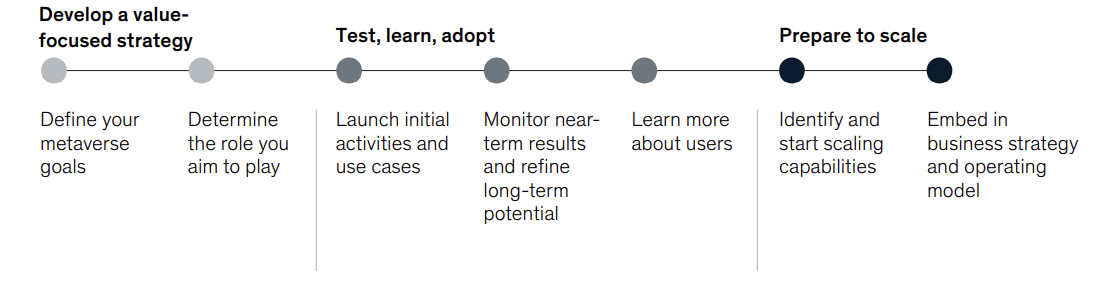
Develop a value-focused strategic stance
- Define your metaverse goals. This includes figuring out whether you want to create demand in new and existing segments, build communities, or create new revenue streams.
- Determine the role, you want to play. You can choose from building experiences to facilitating interactions and enabling infrastructure.
Test, learn, and adopt
- Start by doing some activities and using some cases to explore opportunities such as NFTs, immersive experiences, native advertising, and having a metaverse presence.
- Make sure to track how your new business plan is working in the short term, so you can make changes and improve it in the long term. Identify what metrics you will use to measure the success of your initial activations, and also think about potential long-term monetization options.
- Learn more about users by examining their behavior on different platforms and conducting primary research.
Prepare to scale
- Find the right talent and get the necessary tools and technology in place to start scaling your capabilities.
- To improve your business strategy and operations, embed the metaverse in your plans. Also, identify who in your organization will be responsible for driving these initiatives.
Actions for executives to consider
The metaverse is likely to impact how businesses interact with customers. It will also change how companies operate. The human resources department will have new ways to learn and develop new skills and recruit new employees. The strategy team will be able to look at new ways to make money and do business. Using digital twins and new design tools will speed up research and development. The operations function could use the metaverse for general and administrative tasks.
If you want to understand consumers and opportunities that may be available to your organization, you need to be familiar with the metaverse. Make an effort to explore Roblox, Fortnite, Minecraft, or a similar gaming experience.
You may also check out the NFT marketplace, put on a VR headset, and try a new experience. Having a virtual meeting or event on a platform like Gather Town can also give you a chance to explore and experience the metaverse. By doing this, you will be better informed about the possibilities of VR.
Actions for policymakers to consider
Public-sector entities can also use virtual reality to reimagine public services and infrastructure. One key challenge will be finding people with the right skills to help shape what should be done, and then working with technology providers to make it happen.
National and local governments need to figure out when the right time is to start regulating the metaverse. On one hand, it might be hard to create detailed rules and regulations for something that keeps changing. But, on the other hand, governments can already plan and build the structures and capacity needed to stay ahead of changes and respond quickly when necessary. This will also allow them to engage with private-sector stakeholders, and proactively guide the development of the metaverse even outside of concrete regulation.
Conclusion
People and businesses are already exploring ways to connect more and make everyday activities easier. Within a decade, the metaverse could change things a lot. It is possible that by 2030, more than 50 percent of live events will be held in the metaverse. More than 80 percent of commerce could be impacted by what consumers do there, like discovering brands and visiting virtual stores.
The metaverse is too important to ignore. It will have a major impact on our commercial and personal lives, so businesses, policymakers, consumers, and citizens should explore and understand it as much as possible.
Image and source credits: McKinsey&Company
Read next: A detailed guide to Metaverse


