



According to IDC’s Worldwide Augmented and Virtual Reality Spending Guide, Asia/Pacific (excluding Japan) (APeJ) spending on augmented reality and virtual reality (AR/VR) technologies is expected to grow at a compounded annual growth rate (CAGR) of 42.4% (2021-26) and can reach $16.6 billion by 2026.
The growth in AR/VR technology investment is driven by the penetration of the wireless-first strategy amongst enterprises, industries, and public sector organizations. There is however a lack of consumer-friendly AR/VR technology from a retail consumer perspective which is expected to change over the next couple of years. With vendors willing to improve VR goggles and AR for smart glasses and phones for disrupting augmented audio technology, the consumer market will see promising growth opportunities.
“The impressive market growth for AR/VR technologies is driven by organizations’ demand for a new immersive experience in the way they do business and interact with clients and employees. But vendors also need to respond to AR/VR consumer applications to not miss out on high growth opportunities in the next few years,” says Dr. Lily Phan, Research Director for Future of Work, IDC Asia/Pacific.
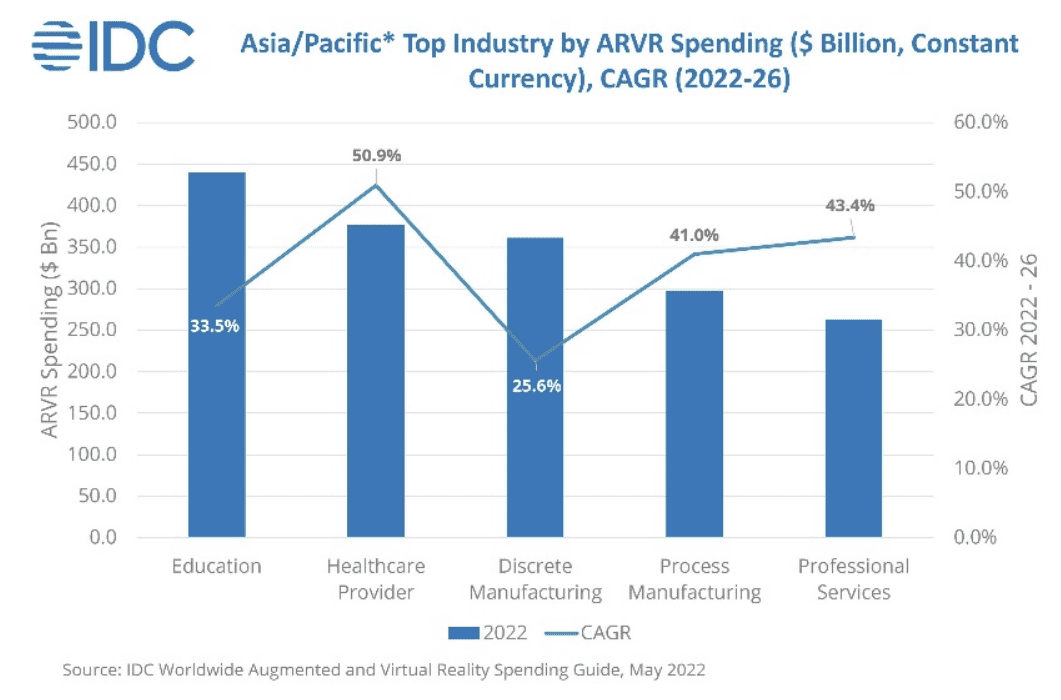
As per IDC, the highest spending industries – education, healthcare, discrete manufacturing, process manufacturing, and professional services, have registered 65% of 2022 spending for commercial use cases among the 19 industries covered by it.

Training was the top priority for investment among the five industries shown above. In 2022, 60% of the investment was captured by the top five use cases of which training captured the largest revenue share and grew by 44.7% from 2021. Along with collaboration, in 2022, it will capture a spending share of 30.1%. The metaverse will act as a collaborative space for partners, employees, and customers. Virtual Reality gaming is the most significant contributor to consumer industries due to its immersive experience that enhances the user’s sense of reality in gameplaying.
“Customer agility is one of the primary aspects driving investment in AR/VR technology. It helps in improving the customer journey by offering an immersive experience,” says Abhik Sarkar, Market Analyst at IDC Asia/Pacific IT Spending Guides, Customer Insights & Analysis.
In 2022, investments in VR will contribute to around 66% of the total market. The contribution is driven primarily by consumer adoption of virtual reality games. By 2026, VR training and collaboration will see more investments in VR technology. Training, retail showcasing, and industrial maintenance will attract more investments in AR technology. For both AR and VR, the maximum investment in 2022 will be for hardware, followed by software and services. With this trend expected to remain the same from 2021 to 2026, hardware will grow at a CAGR of 48.1%, software with 47.1%, and 20.8% for services.


