



According to a research by IDC, the factors driving the adoption of artificial intelligence (AI) in APAC are shifting from internal-focused hygiene factors to more external-focused factors like driving product and service differentiation and improving customer experience. AI can enable organizations to increase their ability to generate revenue digitally, which is a key capability to compete in the digital-first world. Those that have invested in it are seeing concrete benefits, so AI spending is increasing among the best organizations. This is creating a large gap between leaders and laggards when it comes to AI capabilities.
Where are APAC organizations spending on AI?
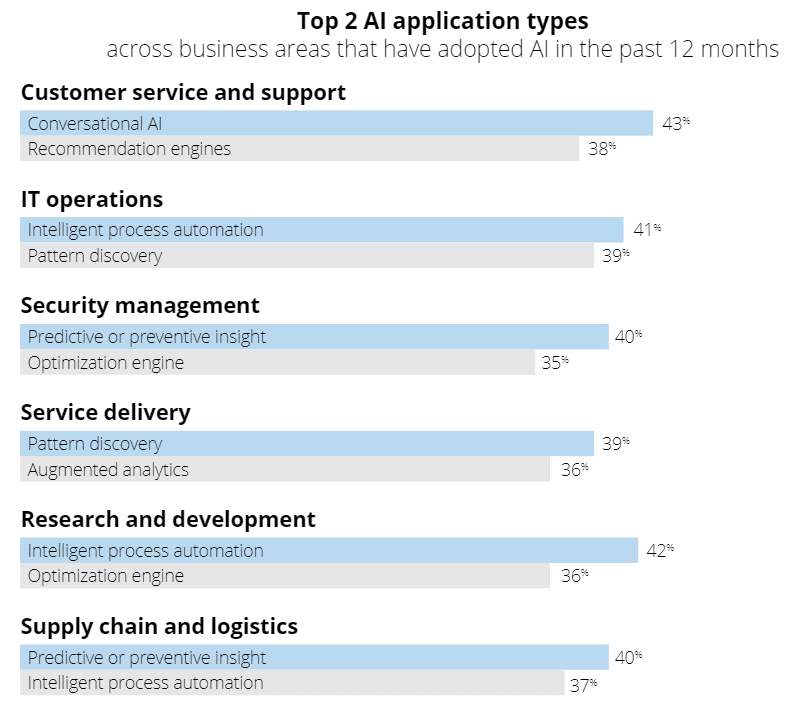
About 80% of APAC organizations that have adopted AI have applied it in more than five horizontal business processes. Many horizontal applications that use machine learning are customer-facing. This means that they are used to help customers in ways such as providing them with a better experience or understanding their needs.
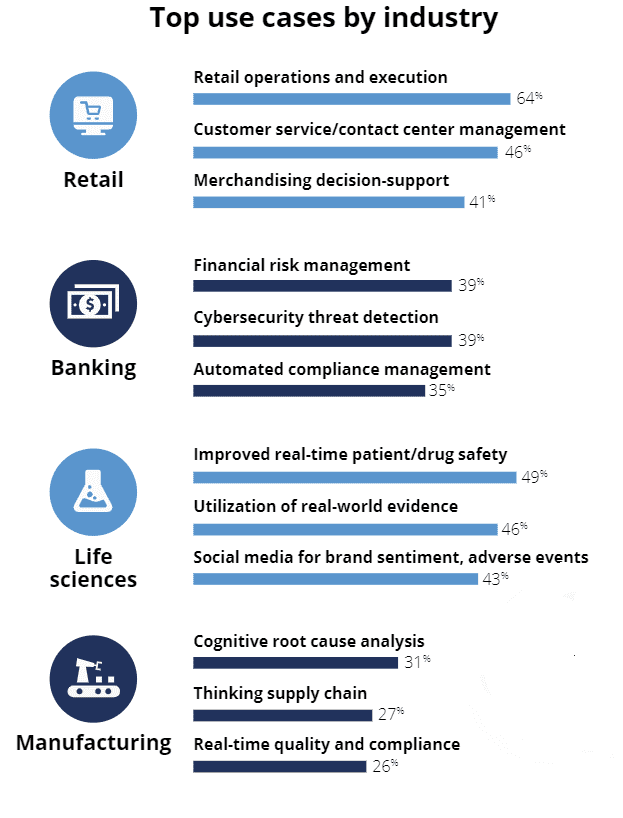
However, most of the leading use cases for machine learning are industry specific. This means that they are used in specific industries to do things such as risk management in banking, store and channel operations in retail, and drug safety in life sciences. These applications tend to be more complex and predictive, but they can also add more business value.
The emerging AI capabilities divide in APAC
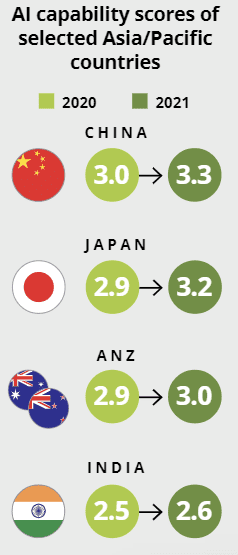
The leaders are getting better at AI while the laggards are not improving as much. This suggests that there will be a bigger divide between the groups in the future. The organizations that can do AI well will have an advantage in the digital economy. The scores for how well organizations are doing with AI show where different countries stand in the APAC region.
To get consistent returns from AI, enterprises need four core capabilities: data, people, technology, and process.
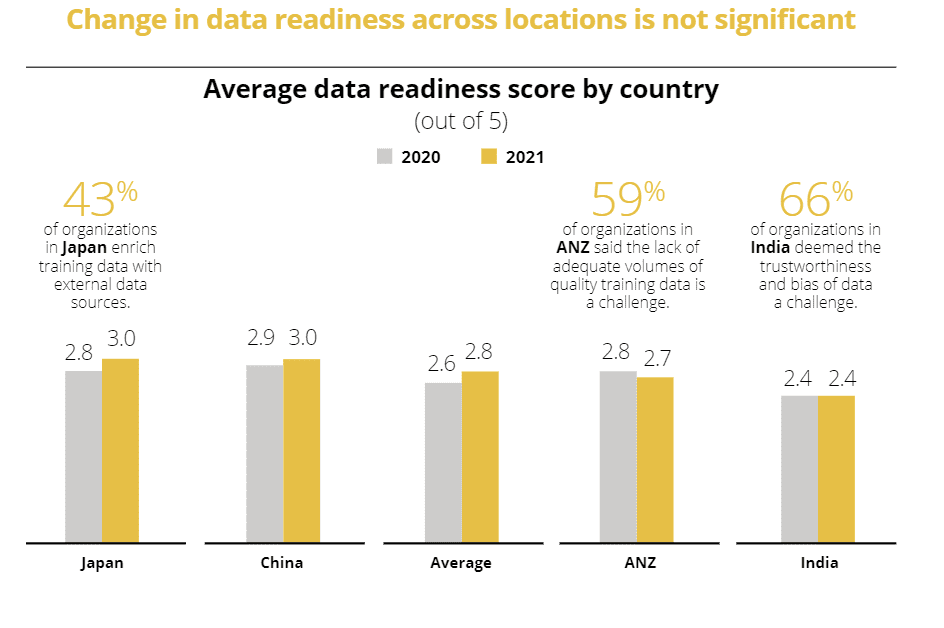
Data capabilities: It includes the abilities in data acquisition, preparation, and life-cycle management for supporting decision making, and model and application development. Data readiness is important for customized AI development and implementation. According to the research, in APAC organizations that invested in AI, the average data readiness score has only increased slightly from 2.6 to 2.8 out of 5.
People capabilities: 58% of organizations in APAC highlighted the lack of skilled personnel as a challenge to making AI work. The challenges of managing people to support AI innovation take time to overcome and demand leadership to nurture a pro-change, pro-data work culture.
Organizations in the early capability stages appoint executive champions, build centers of excellence (COEs), and allocate dedicated roles to accelerate change from the top down. Those in the later capability stages empower and incentivize data scientists to stay and get more business users to upskill and share AI best practices.
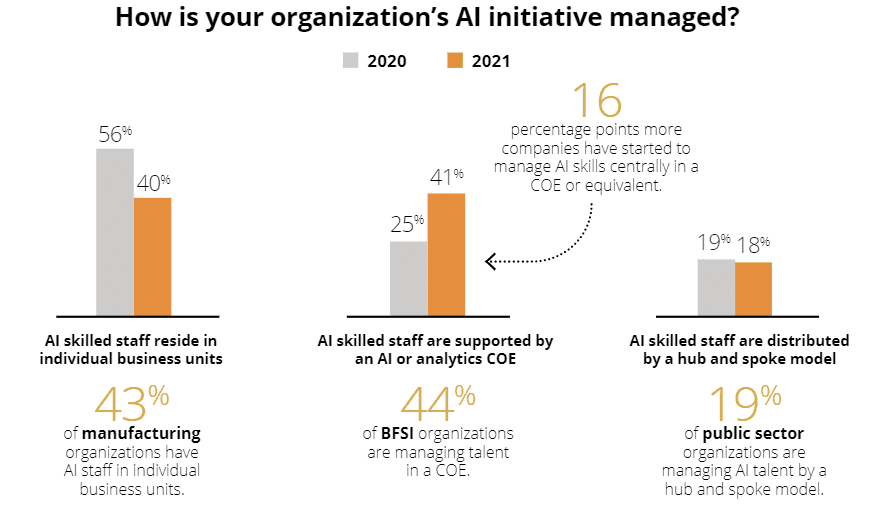
Technology capabilities: The spending on AI model building and application development software platforms in APAC is expected to grow at a five-year CAGR of 33% and reach US$9.4 billion in 2025. 25% of this amount will be spent on AI life-cycle management software. China, Japan, Australia, Singapore, and South Korea lead in spending in 2022.
63% of organizations that invest in AI need to rebuild their models weekly, or more frequently. Therefore, a platform to orchestrate workflows and automate training cycles is a must for ensuring the timeliness and consistency of model delivery and update. 35% of organizations in South Korea and Singapore have reported that the lack of an integrated development environment is failing some AI projects.
Process capabilities: A process capability establishes the metrics and processes for data operations, model operations, and associated business operations for ensuring the discipline required for consistent and superior business performance. Despite more AI models, only 25% of AI models have reached the production stage in 2021. APAC organizations still need to improve their ability to scale model delivery.
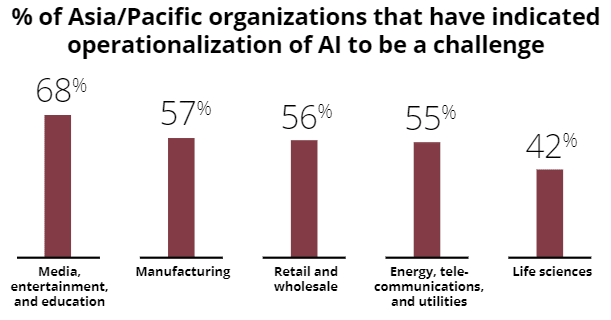
It takes time to develop these capabilities and an enterprise-wide strategy is needed for coordinating investment and delivering business value. However, only less than 40% of APAC organizations have an enterprise-wide strategy to coordinate their AI investments.
How to overcome challenges and reduce the divide?
- Appoint an AI model steward or AI risk specialist to oversee the governance protocols and practices of the entire data to model life cycle. This is because it can be challenging to ensure governance in the complex and iterative process of model development and management. An AI model steward can ensure that documentation and reviews are done for all roles and all steps involved.
- Challenges in people and process are often two problems arising from one root. Employing technologies that facilitate team collaboration and process automation can resolve these problems. Automation and low-code-no-code features will reduce the skills gap and enable AI professionals to be more productive and focus on higher value-add activities. With automation features, many of the model operations can be designed so that there is less chance for inconsistency.
- Organizations can take the help of data scientists to overcome business problems/challenges and solve real-world problems. For this, they have to collaborate with subject matter experts and continuously grow knowledge in the business domain. In the long run, mature AI organizations must get data scientists for building their skills around specific business problems relevant to their organizations.
Image and source credits: Dataiku
Read next: How can CIOs build the next generation of AI talent?


